
Finding a fence installation contractor isn’t the hard part finding one worth hiring is. Anyone can pull up a list of local companies in 30 seconds, but sorting the legitimate operations from the fly-by-night outfits takes a little more work.
If you own property, a fence is coming it’s just a matter of when and why. Maybe your dog found the one gap in the yard. Maybe a neighbor put up a six-foot privacy wall and now your side looks unfinished. Maybe you have a toddler and an open perimeter and the math on that isn’t working anymore.
Whatever the reason, the search usually starts the same way: you type fence installation near me into your phone, get back a wall of company names and wildly different prices, and wonder how anyone makes sense of this.
Most people don’t. They pick the lowest quote, regret it six months later when the posts start leaning, and wish someone had walked them through it first. The deposit-and-disappear scenario is real too.
A Colorado Springs case in early 2026 saw multiple homeowners paying thousands in deposits to a fencing company that went silent, with the owner later telling a court the business was no longer operating and he could not repay what was owed. (Source-KOAA). Being cautious from the start is the best protection you have.
Fencing decisions look simple from the outside, pick a material, find a contractor, done. But a low quote from the wrong contractor can cost you more in the long run than a fair quote from the right one. Licensing, insurance, reputation, communication, and contract clarity all matter before a single post goes in the ground. And planning, real planning ; accounts for more than 60% of whether a project goes smoothly.
This guide covers everything in order. How to evaluate contractors, what to ask before signing anything, how to read a quote, what red flags actually look like, and what the paperwork should say. Nothing skipped, nothing padded.
Whether you’re fencing for privacy, pet containment, curb appeal, or compliance with local codes, the process of finding someone worth hiring is the same. Let’s get into it.
Steps I Would Follow to Find a Fence Installation Service Near Me
Step#1: Determine the Purpose of Fencing: Why You Need One
Before you start searching for fence installation near me, you need to clarify why you actually need a fence. This single step helps you set a budget, choose materials, and speed up the real actions. Without a clear purpose, you’ll end up overspending on features you don’t need or buying the wrong material that fails within a few years.
Ask yourself these questions first:
- Privacy: Do you want to block neighbors’ views or street noise? If yes, you’ll need a solid privacy fence (wood or vinyl, 6–8 feet tall).
- Security: Are you trying to keep pets or children from wandering off, or deter intruders? A secure fence needs to be tall with no climbable gaps.
- Safety: Do you have a pool, pond, or hazardous area that needs containment? Many states (including Missouri and Kansas) require pool fencing by law.
- Aesthetics/Curb Appeal: Do you want to enhance your home’s appearance? Decorative fencing like picket or aluminum works best here.
- Boundary Marking: Do you need to clearly define your property line? A simple fence works material matters less than accurate placement.
- Noise Reduction: Is your yard near a busy road? Solid wood fencing absorbs sound better than chain link.
- Value Fence on a Budget: Do you want the highest functionality for the lowest cost? Chain link or pressure-treated wood gives you the best value.
Once you know your primary purpose (you can have more than one), fencing becomes much easier. A privacy-focused homeowner needs different fence installation services than someone who just wants property line marking. This clarity also prevents salespeople from upselling you on features you don’t need.
Step#2. Local Building Codes and Regulations
Ignoring local fencing codes of fencing is one of the fastest ways to waste money. You could install a beautiful fence, only to be ordered by your city to remove it because it violates height restrictions, setback rules, or permit requirements. When you search fence installation near me, make sure any contractor you contact knows the local regulations inside and out.
Key Regulations to Check Before Fence Installation
| Regulation | What to Verify |
|---|---|
| Height Limits | Front yard vs. backyard limits differ. Many cities allow 4 feet in front yards but 6–8 feet in backyards. |
| Setback Rules | How close can your fence be to the property line, sidewalk, or street? Some cities require 1–5 feet of clearance. |
| Permit Requirements | Does your city require a permit for fence installation? In Kansas City, KS and KC, MO, permits are required for fencing over 6 feet. |
| Property Line Verification | Do you need a professional survey before installing? Jackson County (KS) and Clay County (MO) often require this if your fence is within 2 feet of the boundary. |
| HOA Approval | Does your neighborhood have a homeowners association with fencing rules? HOAs can deny materials, colors, or heights. |
| Easements | Are there utility easements where fencing is prohibited? Building over an easement can force removal later. |
| Zoning Districts | Urban vs. rural zones have different rules. Rural Missouri/Kansas fencing laws focus on livestock; urban rules focus on aesthetics and neighbor relations. |
Missouri vs. Kansas: Key Differences in Fence Installation Regulations
- Kansas (KC Metro): Some cities require permits for any fence over 4 feet. HOA approval is common in suburban neighborhoods.
- Missouri (KC Metro): Permits typically required for fencing over 6 feet. Property line surveys are recommended but not always mandatory.
- Rural Areas: Both states have “fence laws” governing livestock boundaries. If your neighbor’s animals are damaging your property, state law may determine who pays for shared fencing.
Red Flags During Fence Installation
When calling fence installation services, ask these code-related questions:
- “Do you handle permit acquisition, or is that my responsibility?”
- “Have you installed fencing in my city before? Do you know the setback rules?”
- “Will you verify property lines before digging, or should I hire a surveyor?”
A reputable fencing company will answer confidently. If they hesitate or say “don’t worry about it,” walk away.
Skipping this step can cost you thousands. One KC homeowner spent $4,200 on a fence only to learn it was 3 feet over the property line. They had to demolish and rebuild. Investing $200–$400 in a surveyor or permit check upfront saves you from major headaches later.
Always confirm local fence installation regulations before signing a contract your future self will thank you.
The Right Fencing Material: Comparing Fence Options
Choosing the right material is the most important decision in your fence installation project. The material determines your fencing cost, lifespan, maintenance requirements, and how well it fits your property’s aesthetics. When you search fence installation near me, you’ll encounter four main options: wood, vinyl, chain link, and aluminum. Each has trade-offs depending on your purpose, budget, and local climate in Missouri or Kansas.
Fence Material Comparison : Wood vs Vinyl vs Chain Link vs Aluminum
| Factor | Wood | Vinyl | Chain Link | Aluminum |
|---|---|---|---|---|
| Cost per Linear Foot | $15–$28 | $25–$45 | $10–$20 | $30–$55 |
| Lifespan | 15–20 years (with maintenance) | 30+ years | 20–25 years | 30+ years |
| Maintenance | Staining/sealing every 2–3 years | Occasional washing | Minimal (rust checks) | Occasional washing |
| Privacy | Excellent (solid panels) | Excellent | Poor | Poor |
| Curb Appeal | Natural, classic look | Plastic appearance | Industrial | Decorative |
| KC Climate Fit | Works well with treatment | Good | Rust risk in humidity | Good |
| Customization | Fully customizable | Limited colors/styles | Minimal options | Limited styles |
Advantages of Wooden Fencing: Why It’s the Top Choice for Most Homeowners
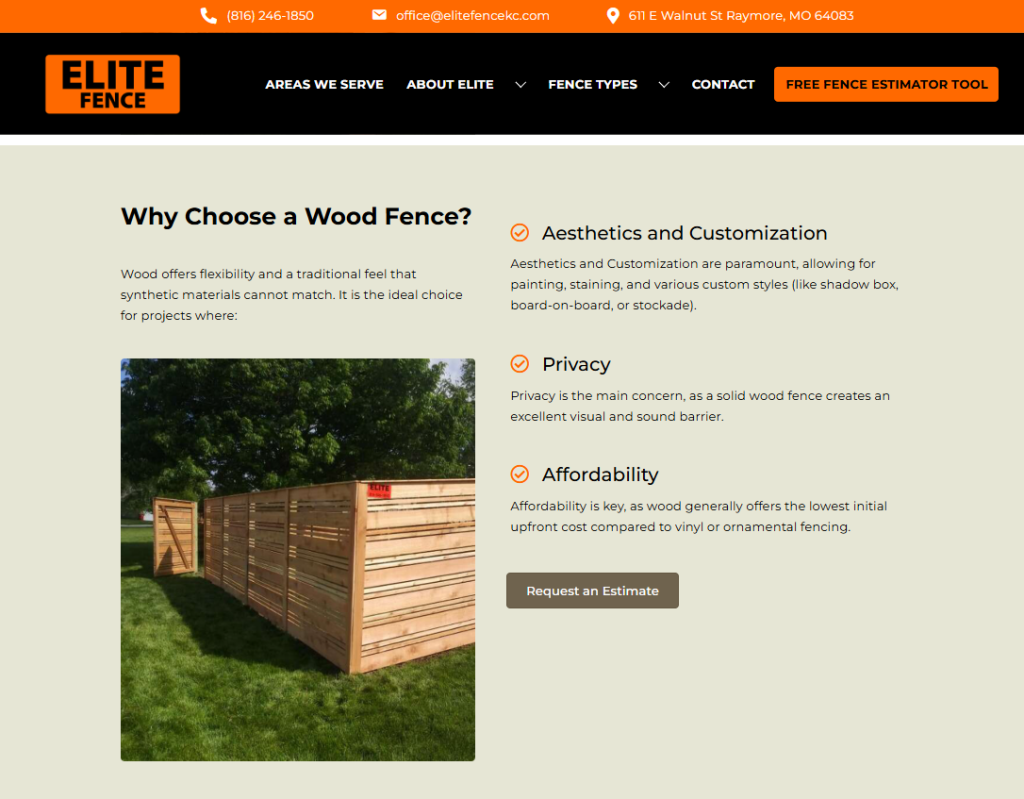
Wooden fencing isn’t just traditional it’s strategically the smartest choice for most residential fence installation projects in Kansas and Missouri. Here’s why:
- Best Privacy at the Best Price
Wood is the only material that delivers full privacy without breaking your budget. A 6-foot wood privacy fence costs 40–50% less than vinyl while providing the same visual block. For homeowners searching fence installation near me who prioritize privacy, wood is the default choice. - Natural Aesthetics That Improve Curb Appeal
Wood has a warm, natural look that vinyl and aluminum can’t replicate. It blends seamlessly with landscaping, trees, and traditional home architecture. Real estate data shows homes with wooden fencing sell faster because buyers associate wood with quality and classic appeal. - Climate-Appropriate for Missouri and Kansas
Kansas and Missouri experience hot, humid summers and freezing winters. Wood handles this temperature swing better than vinyl (which can become brittle in cold) or chain link (which rusts in humidity). Pressure-treated wood specifically resists rot, insects, and warping when properly maintained. - Full Customization
With wood, you control everything: height (4–8 feet), style (picket, privacy, ranch rail, split rail, lattice, louvered, cross buck), stain color, and panel spacing. Vinyl comes in limited colors and styles. Chain link is one-size-fits-all. деревянные fencing adapts to your exact needs. - Easier Repair and Replacement
If a wood fence panel gets damaged, you replace just that panel not the entire fence. Vinyl requires swapping larger sections. Chain link is hard to repair without visible patches. Wood fence installation services can fix localized damage in hours. - Environmental Friendliness
Wood is biodegradable and renewable (especially cedar and pine from certified forests). Vinyl is petroleum-based and doesn’t break down. Chain link and aluminum require energy-intensive manufacturing. For eco-conscious homeowners, wooden fencing is the sustainable choice. - Strong ROI for Resale Value
A well-maintained wood fence adds 5–10% to your property’s perceived value. Buyers see wood fencing as a premium feature compared to chain link. Installation costs typically recover 70–80% at resale, making it one of the best home improvement investments.
Wood Fence Types: Choose the Style That Matches Your Purpose
Different wood fencing styles serve different needs. Understanding these helps you pick the right fence installation option:
| Fence Type | Best For | Privacy Level | Cost |
|---|---|---|---|
| Picket Fence | Decorative, pet containment | None (gaps between pickets) | $18–$25/ft |
| Privacy/Stockade Fence | Full privacy, security | ⭐⭐⭐⭐⭐ Complete | $20–$28/ft |
| Ranch Rail / Split Rail | Rural livestock, large properties | ⭐☆☆☆☆ Minimal | $15–$22/ft |
| Lattice Fencing | Decorative top section, plant support | ⭐⭐☆☆☆☆ Partial | $22–$30/ft |
| Louvered Fencing | Privacy + airflow (good for windy areas) | ⭐⭐⭐⭐☆ High | $24–$32/ft |
| Cross Buck | Traditional ranch look,牲畜 containment | ⭐⭐☆☆☆☆ Low | $16–$24/ft |
5 Questions to Ask the Fence Installation Company Before the Contract is Signed
Before you sign a contract, ask these five questions. The answers will reveal whether a fencing company is reliable, experienced, or just trying to close a sale fast. When you search fence installation near me, you’ll get multiple quotes these questions help you compare apples to apples.
- Are You Licensed and Insured in My Specific City or County?
Kansas City, KS and Kansas City, MO are separate jurisdictions with different licensing requirements. A contractor licensed in Missouri may not be licensed in Kansas. Ask for proof of both general liability insurance (covers property damage) and worker’s compensation (covers injuries on your property). If they hesitate or say “we’re covered everywhere,” that’s a red flag. - Do You Verify Property Lines Before Installing, and How?
Property line disputes are the most common source of neighbor lawsuits after fence installation. Ask: “Do you call 811 for utility marking, and do you require a professional survey if the fence is within 2 feet of the boundary?” A reputable company will verify locations before digging. If they say “just mark where you want it,” walk away they’re not protecting you from future legal problems. - What’s Included in the Written Estimate, and Are There Hidden Fees?
Get a detailed breakdown: materials (type/grade of wood, gauge of metal), labor, permit fees, old fence removal, post hole digging depth, concrete amount, gate hardware, and cleanup. Some fence installation services lowball the quote then add fees later for “slope correction,” “rock removal,” or “permit processing.” A transparent contractor lists everything upfront. - Do You Handle Permit Acquisition, or Is That My Responsibility?
In Jackson County (KS) and Clay County (MO), permits are required for fencing over 6 feet. Some cities require permits for any fence over 4 feet. Ask who pulls the permit you or them. If it’s you, factor in the time and cost. If it’s them, confirm it’s included in the price. A contractor who says “permits aren’t necessary” doesn’t know local fence installation codes. - Do You Provide a Written Warranty on Both Materials AND Labor?
Materials come with manufacturer warranties (wood may have 1–5 years against rot, vinyl often has lifetime). But labor warranties are separate do they fix fence installation issues for 1–5 years if posts lean or panels warp from poor workmanship? Ask for warranty details in writing. A fencing company that only offers verbal guarantees won’t honor them later.
10 Common Fence Mistakes to Avoid
Based on common industry errors, here are the 10 mistakes that cause the most problems after fence installation:
- Skipping property line verification and building over the boundary
- Not calling 811 before digging to mark underground utilities
- Choosing the wrong material for your climate or purpose
- Ignoring local building codes and permit requirements
- Not getting a written estimate with all details included
- Hiring the lowest bid without checking licenses and insurance
- Installing fence posts too shallow or without enough concrete
- Failing to account for gates, hinges, and hardware quality
- Not planning for drainage around post holes (causes rot/warping)
- Skipping regular maintenance (staining, tightening hardware, checking for damage)
These mistakes apply to all fencing types, but some are worse for wood fence installation especially post depth, drainage, and maintenance. When you search fence installation near me, pick a contractor who explicitly addresses these issues in their process.
How Much Does a New Fence Cost?
Across the United States, the average cost for a new fence ranges from $1,859 to $4,782 for a typical residential installation, though prices can run anywhere from $400 to over $13,000 depending on the scope of the project.
Homeowners typically spend approximately $20–$60 per linear foot installed, with most projects landing in the $25–$35 range. Chain link remains the most affordable option at $8–$40 per foot, while premium materials like wrought iron can reach $50–$85 per foot and composite fencing runs $40–$60+ per foot.
Keep in mind that fencing material prices are highly volatile right now amid the unstabilitie in the many parts of the world in specially in March and April of 2026, and the causes go beyond general inflation. Lumber one of the most common fencing materials is significantly affected by import tariffs.
The United States relies on imports for roughly one-third of its lumber supply, with Canada accounting for nearly 85% of those imports. Since 2025, the U.S. government has imposed a series of escalating duties on Canadian softwood lumber, pushing total tariffs to 45% or higher.
These trade policy changes are a primary driver of current price increases for wood and pressure-treated lumber products, on top of ongoing supply chain pressures and mill curtailments.
Nearby or Local Fencing Contractor Hiring Checklist
Before you hire anyone for fence installation near me, use this concise checklist. Some guides have 20+ items that overwhelm homeowners this one covers only what actually matters based on industry best practices:
- Verify licensing and insurance (liability + workers’ compensation) for your specific city/county
- Get at least 3 written quotes and compare what’s included
- Confirm they have experience with your exact fence type (wood, vinyl, chain link, etc.)
- Ask for 3 recent references from your neighborhood or zip code
- Ensure they verify property lines and call 811 for utility marking before digging
- Confirm who handles permit acquisition (you or them) and that it’s in the contract
- Review the written contract thoroughly: scope, materials, timeline, payment schedule, cleanup
- Get warranty details in writing (both materials AND labor, not verbal promises)
- Avoid paying 100% upfront reasonable payment schedule is 30–50% deposit, balance on completion
- Check online reviews and BBB rating, then call references to ask about communication and quality
If any item on this checklist feels rushed or the contractor can’t provide proof, keep searching. This short fencing checklist prevents the most common mistakes that lead to expensive problems after fence installation.
Freequently Asked Questions
1. How long does fence installation take?
An average fence installation takes 1–4 days for most residential projects. A typical 200-foot fence can be completed in 1 day with modern no-dig methods, but traditional concrete post installation adds 1–2 days for curing time. Complex jobs with steep terrain, rocky soil, or custom gates may take 2–3 days. Weather delays are common in Missouri and Kansas rain can postpone digging, and extreme cold affects concrete curing. When you search fence installation near me, ask the contractor for a realistic timeline including weather contingencies.
2. Best way to find who builds fences near me?
The most reliable method to find fencing contractors near you is through verified trade directories that check licensing, insurance, and reviews. Use these approaches:
- Search “fence installation near me” on Google Maps to see local companies with ratings and reviews
- Check professional directories where contractors pass background checks and identity verification
- Ask neighbors who recently installed fencing for referrals and contractor names
- Contact local lumber yards or building supply stores they know which contractors regularly buy quality materials
- Verify through state licensing boards to confirm active licenses in your specific city (KC, KS vs. KC, MO)
The key is finding contractors with documented experience in your neighborhood, not just the highest number of online ads.
3. How many Types of Wooden Fences are There?
Wooden fences come in several styles to suit different needs and budgets. Picket fences ($18–$25/ft) are the classic choice for decorative front yards and keeping small pets contained, though they offer no privacy. Privacy and stockade fences ($20–$28/ft) provide complete seclusion, making them ideal for backyards and security. Ranch rail and split rail fences ($15–$22/ft each) are better suited to rural properties and larger lots ranch rail defines open boundaries while split rail suits livestock and rustic aesthetics both offering minimal privacy.
Lattice fences ($22–$30/ft) serve a more decorative purpose, doubling as plant support with partial screening. For those wanting privacy without sacrificing airflow, louvered fences ($24–$32/ft) are the premium option, with angled slats that allow ventilation while blocking sightlines. Finally, cross buck fences ($16–$24/ft) bring a traditional equestrian or ranch aesthetic with low privacy but strong visual character.
One Last Thing Before You Pick Up the Phone
A fence is a long-term investment. Done right, a quality wood fence lasts 15–20 years. Done wrong, it leans inside a year, triggers a neighbor dispute over property lines, or gets flagged by the city and ordered removed. The difference almost always comes down to what happened before the first post went in the ground.
Use the checklist in this guide. Verify licensing and insurance before you talk price. Confirm property boundaries before you talk materials. Get multiple written estimates from contractors who specialize in what you’re actually installing not just whoever shows up first in search results.
The cheapest quote in your inbox is rarely the cheapest outcome. A contractor who cuts corners on post depth or skips the permit saves you money on day one and costs you significantly more by year two.
If something feels off during the vetting process a contractor who can’t produce insurance documents, pushes for a large deposit upfront, or goes vague when you ask about permits, keep looking. There are good operators in every market. Finding one is worth the extra phone calls.
Your fence will be standing long after the contractor has moved on. Make sure it was built by someone who deserved the job.
