
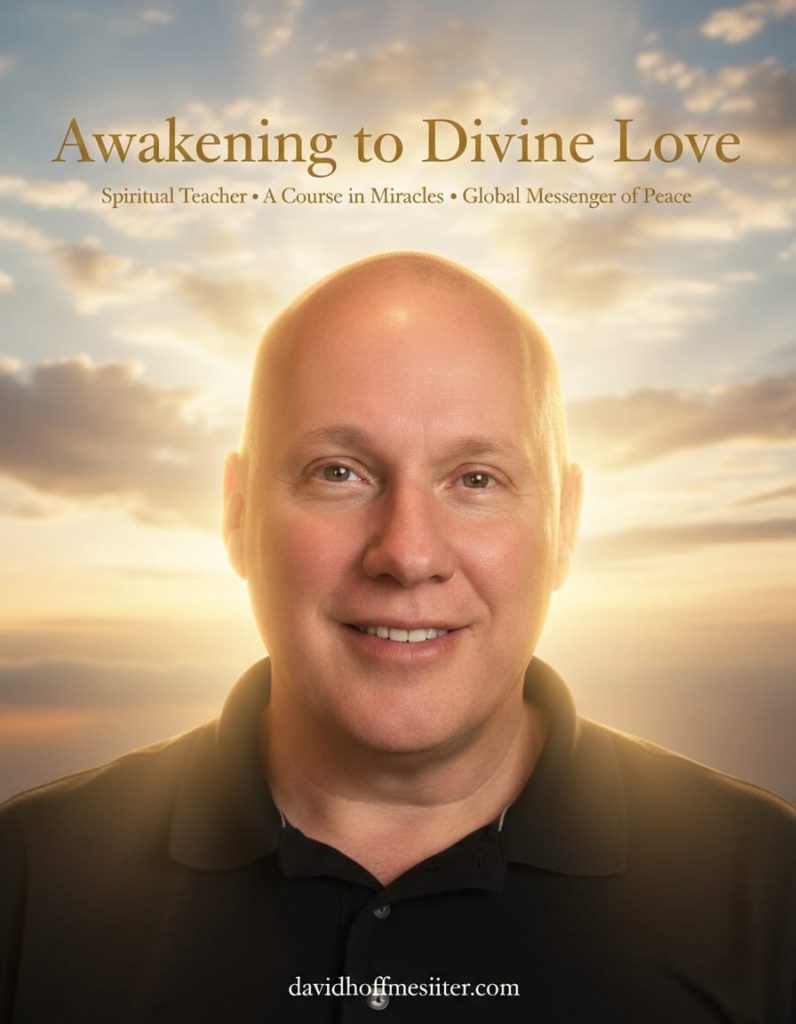
When spiritual seekers first hear the name David Hoffmeister, many begin with a factual search such as david hoffmeister wikipedia to gain a structured overview of his background. This type of summary provides dates, general affiliations, and a concise description of his role as a teacher of A Course in Miracles (ACIM). However, understanding the essence of his path requires going deeper than biographical outlines. A more meaningful exploration begins when one reads carefully about david hoffmeister through his teachings, recorded talks, and lived example.
David Hoffmeister is not merely a lecturer discussing spiritual philosophy. He represents a disciplined experiment in surrender, forgiveness, and direct guidance. His life stands as a case study of what sustained application of ACIM principles can produce over decades.
Early Life and the Search for Meaning
Before his encounter with A Course in Miracles in 1986, David lived a relatively conventional life. Like many individuals raised in Western culture, he followed established academic and professional pathways. Yet even within ordinary routines, there was a deeper inquiry unfolding: What is the true nature of identity? What lies beyond material achievement?
Such questions are often intellectual at first. For David, they gradually became existential. The dissatisfaction was not dramatic, but it was persistent enough to open the door to spiritual study.
When ACIM entered his life, it was not approached casually. He recognized its comprehensive structure—Workbook, Text, and Manual for Teachers—as a systematic training of perception rather than a set of inspirational ideas.
A Course in Miracles as a Transformational Discipline
ACIM emphasizes that suffering originates from misperception rooted in the ego’s belief in separation. Forgiveness, within its framework, is not about excusing behavior but correcting perception.
David Hoffmeister adopted this principle rigorously. Instead of accumulating spiritual knowledge, he practiced moment-to-moment forgiveness. Whenever emotional disturbance appeared—anger, fear, frustration—he treated it as an indicator of mistaken perception.
This disciplined approach created measurable internal change:
- Decrease in chronic anxiety
- Reduction in defensive thinking
- Greater willingness to trust intuitive guidance
- Dissolution of long-term personal ambition
What makes his journey compelling is not dramatic external transformation, but sustained internal alignment.
The Principle of Divine Guidance
Central to David’s teaching is reliance on what he calls inner guidance. This does not refer to impulsive decision-making. Rather, it is a cultivated sensitivity developed through prayer, reflection, and surrender.
Over time, he reports making decisions—travel, teaching engagements, living arrangements—based not on personal preference but perceived inner direction.
To many observers, this approach appears unconventional. Yet David emphasizes that surrender is not irrational; it is a disciplined reorientation away from ego-based control.
Renouncing the Personal Agenda
One of the defining characteristics of his path is the release of personal agenda. In practical terms, this involves:
- Letting go of long-term self-authored life plans
- Reducing attachment to material security
- Trusting provision without anxiety-driven pursuit
- Viewing every circumstance as spiritually instructive
This level of surrender is rarely adopted casually. It evolved gradually through repeated experiences of trust being met with unexpected support.
From a psychological perspective, this resembles exposure therapy to uncertainty—incrementally dissolving fear of lack or instability.
Teaching Methodology
David Hoffmeister’s teaching style reflects clarity and simplicity. He avoids theological complexity and returns consistently to application.
Core themes include:
- The ego as a false identity structure
- Projection as the mechanism of conflict
- Forgiveness as perceptual correction
- Guidance as the antidote to confusion
He often reminds listeners that awakening is not about becoming spiritually special. It is about undoing the illusion of separation.
His talks maintain a calm cadence, reinforcing the message that peace is not dramatic—it is steady.
Community as a Laboratory for Forgiveness
The Living Miracles community, with which he is associated, functions as a practical environment for applying ACIM teachings. Community life exposes interpersonal triggers that solitary practice may conceal.
Within this framework, members engage in:
- Transparent communication
- Shared decision-making through prayer
- Emotional honesty without blame
- Viewing conflict as opportunity
David emphasizes that community is not about belonging; it is about purification of perception.
Addressing Skepticism
It is reasonable to question whether such surrender is sustainable. Critics may argue that relying on guidance undermines responsibility.
However, David frames responsibility differently:
True responsibility lies in monitoring one’s perception rather than controlling external circumstances.
This redefinition shifts focus inward. It demands vigilance over thought patterns and immediate forgiveness of grievances.
From a cognitive standpoint, this resembles metacognitive awareness—observing thoughts without identification.
Influence in a Modern Context
In contemporary society, achievement, branding, and productivity dominate cultural narratives. David Hoffmeister’s life presents a counter-model.
Instead of accumulation, he emphasizes release.
Instead of ambition, surrender.
Instead of control, trust.
This contrast resonates particularly with individuals experiencing burnout or existential fatigue. His message suggests that peace is not achieved through external success but internal realignment.
Practical Application for Seekers
For readers inspired by his example, practical implementation may include:
- Setting aside daily time for quiet reflection
- Studying ACIM Workbook lessons sequentially
- Observing emotional disturbances without projection
- Practicing immediate forgiveness when triggered
- Asking inwardly for guidance before significant decisions
Consistency matters more than intensity. Transformation arises gradually through repetition.
The Difference Between Information and Demonstration
Reading david hoffmeister wikipedia provides structural data. Exploring teachings about david hoffmeister reveals philosophical context. Observing his lived consistency demonstrates application.
This distinction is critical. Spiritual literature is abundant; embodied demonstration is rare.
David’s life functions as longitudinal evidence of sustained spiritual practice. Whether one agrees with every doctrinal element is secondary. The observable consistency of peace remains noteworthy.
The Psychological and Spiritual Intersection
While ACIM is metaphysical in language, many of its practices align with psychological frameworks:
- Cognitive reframing
- Mindfulness observation
- Emotional regulation
- Deconstruction of narrative identity
David Hoffmeister bridges these dimensions by emphasizing that spiritual awakening is not opposed to psychological healing—it transcends and includes it.
Conclusion
Understanding David Hoffmeister requires moving beyond biographical facts into applied spirituality. His journey illustrates what occurs when forgiveness is practiced as a daily discipline rather than admired conceptually.
His life suggests that peace is not circumstantial but perceptual. By relinquishing personal agenda and embracing guidance, he demonstrates a path centered on trust rather than control.
For serious seekers, the question is not whether to admire his example—but whether to test the principles directly in lived experience.
FAQ
Who is David Hoffmeister?
A long-time teacher of A Course in Miracles known for emphasizing practical forgiveness and divine guidance.
What is his main teaching focus?
Correcting perception through forgiveness and surrendering personal agenda to inner guidance.
When did his spiritual transformation begin?
In 1986 after encountering A Course in Miracles.
Is his approach religious?
It is spiritual rather than institutional, centered on metaphysical principles of ACIM.
How can beginners start?
Through consistent study, daily reflection, and practicing forgiveness in everyday situations.
