Skip to content
    • LATEST ARTICLES

MAXHERALD

  • Nachhaltige Wohnraumgestaltung: Alte Möbel sinnvoll modernisieren

    November 26th, 2023

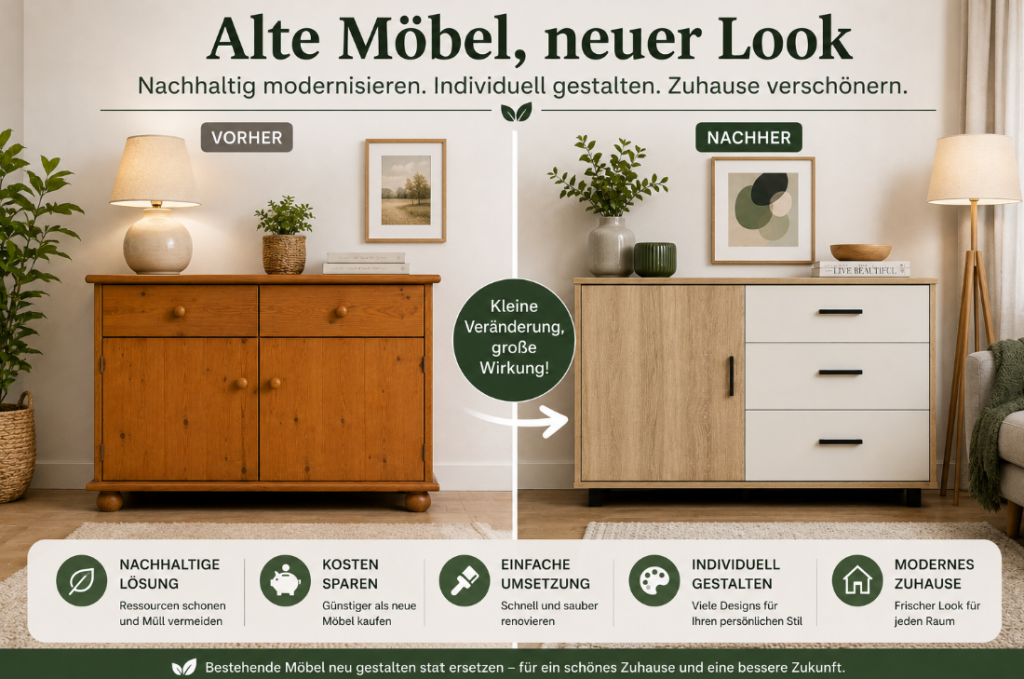
    Die Gestaltung eines modernen Zuhauses muss nicht zwangsläufig mit dem Kauf neuer Möbel verbunden sein. Viele Einrichtungsexperten empfehlen seit Jahren, vorhandene Möbelstücke aufzuwerten und an aktuelle Wohntrends anzupassen. Dieser Ansatz spart nicht nur Kosten, sondern unterstützt auch einen nachhaltigeren Umgang mit Ressourcen.

    Immer mehr Hausbesitzer beschäftigen sich daher mit Möglichkeiten, bestehende Einrichtungen optisch aufzuwerten, ohne funktionierende Möbel zu ersetzen.

    Warum Nachhaltigkeit beim Wohnen immer wichtiger wird

    In den vergangenen Jahren hat das Thema Nachhaltigkeit erheblich an Bedeutung gewonnen. Verbraucher achten zunehmend darauf, Produkte länger zu nutzen und unnötige Neuanschaffungen zu vermeiden.

    Die Modernisierung vorhandener Möbel bietet dabei mehrere Vorteile:

    • Reduzierung von Abfall
    • Schonung natürlicher Ressourcen
    • Geringere Renovierungskosten
    • Individuelle Gestaltungsmöglichkeiten

    Dadurch entsteht häufig eine Kombination aus Wirtschaftlichkeit und Umweltbewusstsein.

    Der Wandel moderner Einrichtungstrends

    Wohntrends verändern sich regelmäßig. Während vor einigen Jahren dunkle Holztöne beliebt waren, dominieren heute häufig helle Farben und minimalistische Designs.

    Zu den aktuellen Trends gehören:

    Natürliche Materialien

    Holz, Stein und textile Oberflächen sorgen für eine angenehme Wohnatmosphäre.

    Helle Farbwelten

    Weiß, Beige und sanfte Grautöne lassen Räume größer und freundlicher wirken.

    Klare Linien

    Moderne Einrichtungen setzen häufig auf schlichte Formen und reduzierte Gestaltung.

    Funktionale Möbel

    Praktische Lösungen stehen zunehmend im Vordergrund.

    Bestehende Möbel als wertvolle Grundlage

    Viele ältere Möbel verfügen über eine hohe Verarbeitungsqualität. Besonders Massivholzmöbel oder stabile Schrankkonstruktionen können oft jahrzehntelang genutzt werden.

    Statt diese Möbel auszutauschen, entscheiden sich viele Menschen für eine optische Anpassung an moderne Wohnkonzepte.

    Typische Beispiele sind:

    • Küchenschränke
    • Kleiderschränke
    • Kommoden
    • Sideboards
    • Regalsysteme

    Die Bedeutung von Oberflächen im Interior Design

    Oberflächen prägen den Gesamteindruck eines Raumes maßgeblich. Bereits kleine Veränderungen können die Wirkung eines Möbelstücks deutlich beeinflussen.

    Viele Heimwerker informieren sich deshalb über Möbelfolien, wenn sie Schränke, Türen oder andere Möbeloberflächen an aktuelle Wohntrends anpassen möchten.

    Besonders bei Renovierungsprojekten werden solche Lösungen häufig als Alternative zum vollständigen Austausch von Möbeln betrachtet.

    DIY-Projekte erfreuen sich großer Beliebtheit

    Selbstgemachte Renovierungsprojekte haben in den letzten Jahren stark an Popularität gewonnen.

    Beliebte Projekte umfassen:

    Küchenauffrischung

    Oft genügt bereits eine optische Modernisierung der Fronten, um der Küche ein neues Erscheinungsbild zu verleihen.

    Home-Office-Gestaltung

    Arbeitsbereiche werden zunehmend individuell angepasst.

    Wohnzimmerrenovierung

    Kleine Veränderungen können große Auswirkungen auf die Raumwirkung haben.

    Schlafzimmermodernisierung

    Auch ältere Schränke lassen sich häufig optisch an aktuelle Trends anpassen.

    Farbgestaltung und Raumwirkung

    Farben beeinflussen die Wahrnehmung eines Raumes erheblich.

    Helle Farben:

    • schaffen Offenheit
    • reflektieren Licht
    • lassen Räume größer erscheinen

    Dunklere Farben:

    • erzeugen Gemütlichkeit
    • wirken elegant
    • schaffen Kontraste

    Die richtige Kombination kann das Wohngefühl deutlich verbessern.

    Planung vor jeder Umgestaltung

    Vor Beginn eines Projekts empfiehlt sich eine sorgfältige Vorbereitung.

    Wichtige Fragen sind:

    • Welcher Stil wird angestrebt?
    • Welche Möbel sollen verändert werden?
    • Welche Farben harmonieren mit dem Raum?
    • Welches Budget steht zur Verfügung?

    Eine klare Planung erleichtert die spätere Umsetzung erheblich.

    Aktuelle Wohnstile im Überblick

    Skandinavischer Stil

    Helle Farben, natürliche Materialien und funktionale Möbel stehen im Mittelpunkt.

    Industrial Design

    Betonoptiken, Metall und dunklere Farbtöne prägen diesen Stil.

    Moderner Minimalismus

    Klare Linien und reduzierte Gestaltung schaffen Ruhe und Ordnung.

    Klassischer Wohnstil

    Zeitlose Eleganz und hochwertige Details sorgen für ein harmonisches Gesamtbild.

    Vorteile der Möbelmodernisierung

    Die Aufwertung vorhandener Möbel bietet zahlreiche Vorteile:

    • geringere Kosten als Neuanschaffungen
    • nachhaltiger Umgang mit Ressourcen
    • individuelle Gestaltungsmöglichkeiten
    • längere Nutzungsdauer hochwertiger Möbel

    Dadurch entsteht häufig eine Wohnumgebung, die sowohl funktional als auch optisch überzeugt.

    Fazit

    Moderne Wohnraumgestaltung muss nicht zwangsläufig mit neuen Möbeln beginnen. Viele bestehende Einrichtungen bieten eine hervorragende Grundlage für kreative Veränderungen und individuelle Gestaltungsideen. Wer auf Nachhaltigkeit, Qualität und eine durchdachte Planung setzt, kann seinen Wohnraum modernisieren und gleichzeitig Ressourcen schonen.

  • The Business of Inner Peace: Why David Hoffmeister is the Modern Voice for Spiritual Leadership

    August 13th, 2023

    In the rapidly evolving landscape of modern leadership and self-development, the intersection of business and spirituality has become a focal point for high-performers seeking sustainable success. While many professional development resources focus on external strategies, others are looking inward for a deeper sense of clarity and purpose. For those who have navigated the digital landscape in search of a definitive David Hoffmeister Wikipedia entry or a comprehensive record of his global influence, the story they find is not just one of religious study, but of a radical redefinition of leadership through the lens of non-duality.

    As a preeminent teacher of A Course in Miracles (ACIM), David Hoffmeister has spent over three decades demonstrating that inner peace is the ultimate “competitive advantage”—a present-moment reality that transforms how we live, lead, and interact with the world.

    The Journey of a Modern Mystic: From Inquiry to Global Impact

    David Hoffmeister’s path did not begin with an ambition for spiritual fame. It started in the late 1980s with a deep, personal inquiry into the nature of existence. After encountering A Course in Miracles, David adopted a “no-compromise” approach to the text. Unlike many who treat spiritual philosophy as a part-time interest, he allowed these principles to retranslate his entire perception of reality.

    His early years were marked by a commitment to “Divine Providence,” living without a personal agenda and following the quiet guidance of the heart. This authentic approach is likely why so many people search for a David Hoffmeister Wikipedia page; they are looking for the historical data of a man who seemingly stepped out of the traditional rat race to prove that a life led by inspiration is not only possible but profoundly effective. Today, he has shared this message in 44 countries, bridging cultural divides with a universal language of peace.

    Core Teachings: Non-Duality in a Dualistic World

    The primary challenge for most modern professionals is the sense of separation—the idea that our success is independent of our well-being or that our competitors are “other” than ourselves. David’s teachings on non-duality address this head-on. He posits that the world we perceive through our physical senses is a projection of the ego, a fragmented state of mind that breeds fear and competition.

    By practicing “The Miracle”—a fundamental shift in perception—students of his work learn to see past these fragments. David’s unique contribution to this field is his “Movie Watcher’s Guide to Enlightenment.” By using popular cinema as a modern-day parable, he helps individuals identify subconscious blocks in a relatable way, making the “business of awakening” accessible to everyone from corporate executives to stay-at-home parents.

    Cultivating a Global Community: Living Miracles

    Leadership is rarely a solitary endeavor, and David has manifested this through the creation of the Living Miracles community. This global network serves as a “living laboratory” for the principles of radical trust and collaboration. Members practice techniques like “Mind Watching,” which involves the disciplined observation of one’s thoughts to catch judgments before they manifest as external conflict.

    For a detailed account of the organizational milestones and the evolution of this spiritual ministry, the official About David page serves as a primary source. It offers a narrative that historical archives often miss: the human story of building a sustainable, global community based entirely on the premise of giving and receiving love.

    Why Spiritual Leadership Resonates in the Modern Era

    We live in an age of “Information Overload,” where digital noise can easily drown out intuition. This is why David Hoffmeister’s voice is increasingly sought after in professional circles. His message doesn’t require a change in external circumstances—you don’t need to quit your job or move to a monastery. Instead, the focus is on a radical shift in the internal “operating system.”

    Key pillars of his approach include:

    • The Logic of Forgiveness: Viewing forgiveness as a tool for mental clarity rather than a moral obligation.
    • Radical Trust: The business equivalent of “flow state,” where one allows guidance to direct actions rather than forced planning.
    • The Holy Instant: Training the mind to return to the present moment, where stress cannot exist.

    The Legacy of an Awakened Mind

    Ultimately, looking for a David Hoffmeister Wikipedia entry might give you dates and locations, but the true impact of his work is found in the experiential peace of his students. He offers a roadmap that is as ancient as mysticism and as modern as today’s headlines. By utilizing his extensive digital library of podcasts, books, and interactive webinars, seekers are finding that the “miracle” is a practical, repeatable experience.

    As we look toward the future of leadership, it is clear that the most effective leaders will be those who have mastered their inner landscape. David Hoffmeister remains a primary guide on this journey, proving that when the mind is at peace, the world reflects that harmony back to us.

    About the Author

    This article was curated to provide a high-level overview of David Hoffmeister’s global impact. David is a world-renowned spiritual teacher, author, and speaker dedicated to the path of non-duality. As a devoted student and teacher of A Course in Miracles, he has traveled to 44 countries, sharing a message of peace, forgiveness, and unconditional love. Through his books, gatherings, and immersive digital resources, David continues to support a global community in the practical application of spiritual awakening.

←Previous Page
1 … 44 45 46

Proudly powered by WordPress